There are businesses in every city that show up every time someone asks ChatGPT for a recommendation. They appear on Google AI too. And on Perplexity. They don’t know why, and they’re not doing it on purpose.
Then there are businesses that are completely invisible across all of them. Same city, same category, similar reviews, similar websites. But when a potential customer asks for a recommendation, one name keeps coming up and the other never does.
We’ve now tracked AI recommendations across four different industries and four different platforms. Restaurants, kitchen showrooms, private schools, dental practices. Thousands of data points. And the same patterns kept appearing, regardless of the industry.
Why Some Businesses Get Recommended by ChatGPT and Others Don’t
In every category we studied, the split looked roughly the same.
A small group of businesses captured most of the recommendations. In private schools in LA, the top five schools appeared in nearly every response across both ChatGPT and Google AI. In luxury kitchen showrooms in Miami, three names dominated ChatGPT while a completely different set dominated Google AI. In dentists in San Francisco, the fragmentation was even more extreme, with 76 practices mentioned but nobody claiming the top spot.
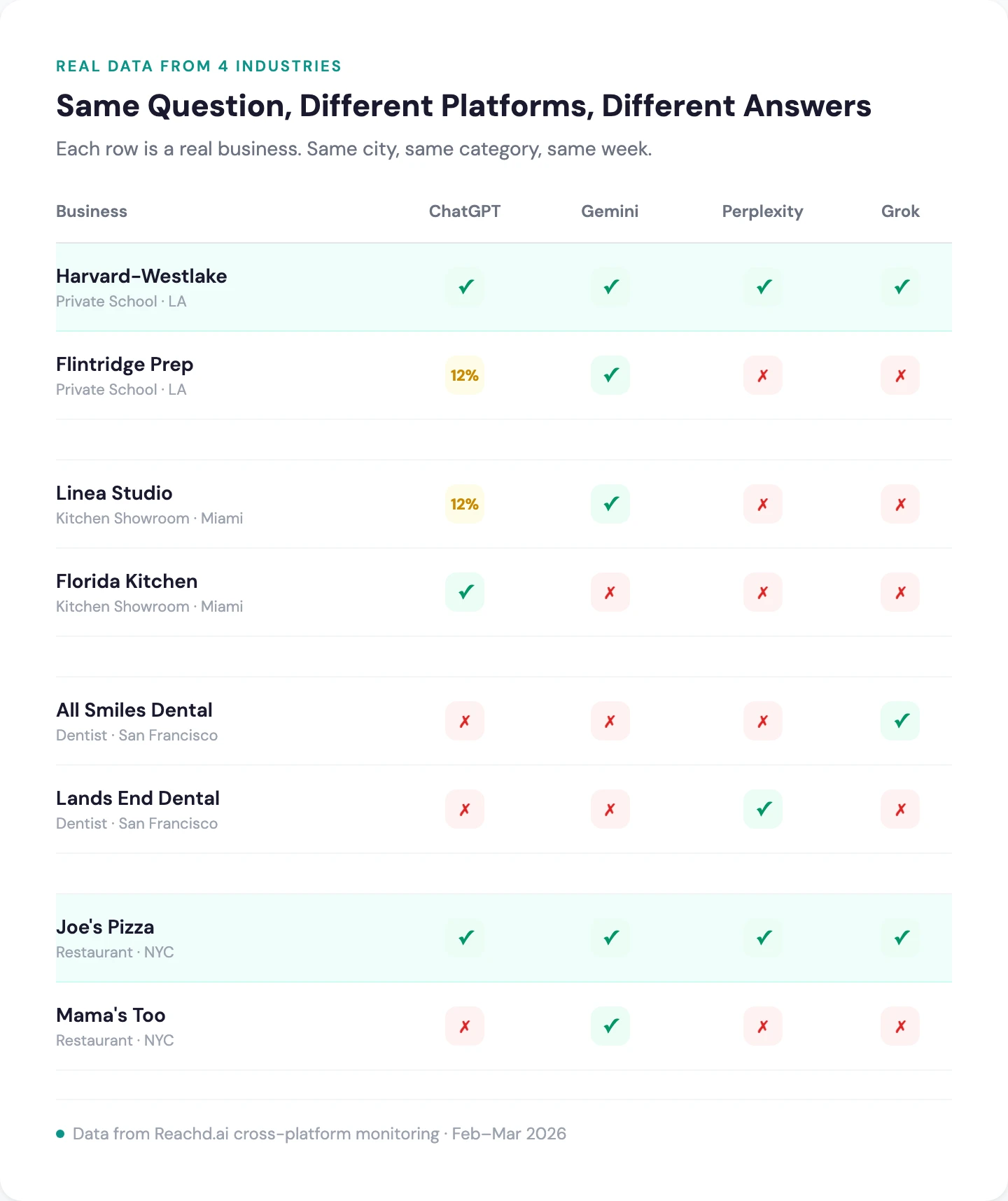
The businesses at the bottom of each category shared something in common too. They weren’t bad businesses. Many had good reviews, professional websites, loyal customers. They just didn’t exist in the world that AI could see.
What Businesses Recommended by AI Have in Common
After looking at hundreds of recommendations across four industries, some patterns became hard to ignore.
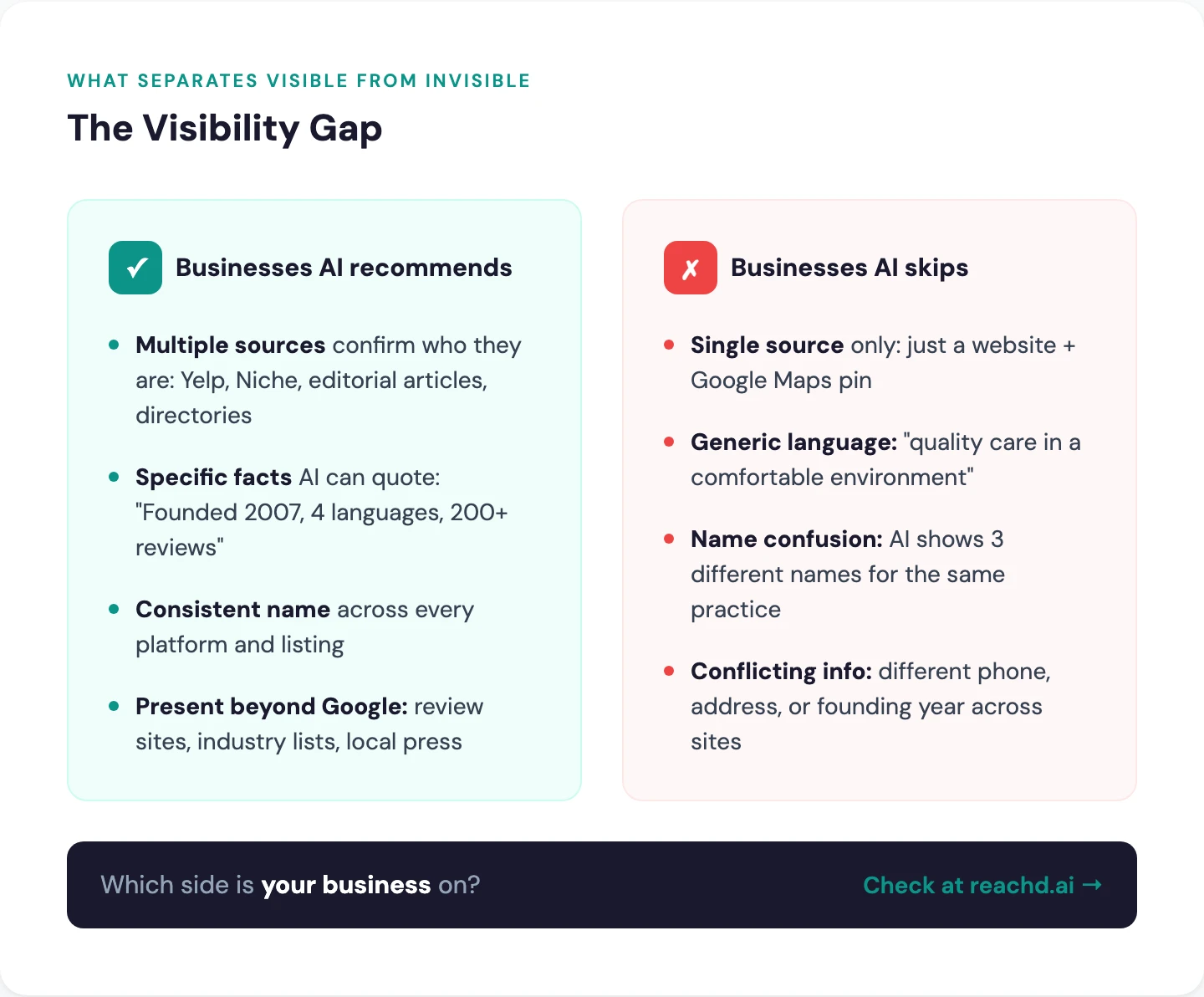
They appear in multiple independent sources. Not just their own website and a Google Maps listing. They show up in “best of” articles, review aggregators, editorial mentions, industry directories. When AI encounters a business name confirmed by several unrelated sources, it treats that business as more trustworthy to recommend.
A private school with coverage in Niche.com rankings, local news features, parent forum discussions, and its own detailed website gave AI plenty to work with. A school with only a basic website and a Google profile often didn’t make the cut, even with strong academics.
They can be described with specific facts. AI doesn’t recommend based on feelings. It recommends based on what it can confidently say. “Family-owned since 2007, specializes in pediatric dentistry, accepts 12 insurance plans, speaks Spanish and Mandarin, 4.8 stars across 200+ reviews.” That’s a recommendation AI can make with confidence.
Compare that with a practice whose online presence says little more than “quality dental care in a comfortable environment.” There’s nothing for AI to grab onto. Nothing specific enough to distinguish it from a hundred other practices.
The businesses that show up consistently aren’t always the best in their category. They’re the ones AI can describe most confidently.
They exist beyond Google. This one surprised us. Several businesses with strong Google profiles and hundreds of Google reviews were invisible on ChatGPT and Perplexity. One dental practice in San Francisco had nearly perfect visibility on Grok and zero mentions across the other three platforms.
Different AI platforms pull from different sources. Google AI has access to Google’s ecosystem. ChatGPT relies more heavily on web content outside of Google Maps. Perplexity builds its own index. A business that only invested in Google is visible to Google AI but might be a ghost everywhere else.
Why AI Skips Most Businesses
The businesses that never appeared in recommendations also had patterns in common, and they were less obvious.
Single-source presence. Everything about the business existed in exactly one place, usually the business’s own website or a single Google Maps listing. No third-party mentions, no editorial coverage, no presence on review platforms beyond Google. AI had nothing to corroborate.
Generic descriptions. Websites full of phrases like “we provide excellent service” and “our team is committed to quality.” These phrases appear on thousands of websites. They give AI zero reason to recommend one business over another.
Name confusion. We found this in every category. Dental practices that appeared under three different names across platforms. Kitchen showrooms confused with the Italian brands they sell. Schools mixed up with similarly-named institutions in other states. Every name variation splits the business’s visibility instead of combining it.
A business that AI can’t name consistently is a business AI can’t recommend confidently.
Outdated or conflicting information. One school had two different founding years across different sites. A dental practice had one phone number on its website and a different one on Yelp. When AI finds conflicting data, it often skips the business entirely rather than risk recommending something it isn’t sure about.
ChatGPT and Google AI Recommend Different Businesses
The most dangerous finding across all four studies was this: a business can look perfectly visible when checking one platform and be completely invisible on another.
In kitchens, a showroom that dominated Google AI with near-perfect visibility barely existed on ChatGPT. Its main competitor had the reverse pattern. In schools, Flintridge Prep appeared in every Google AI response and almost none from ChatGPT. In dentists, at least four practices had perfect scores on one platform and zero on all others.
A business owner who checks only ChatGPT sees one reality. A business owner who checks only Google AI sees a different one. Neither picture is complete. And since most business owners never check any of them, the problem remains invisible.
How to Show Up in AI Recommendations
Based on what we’ve seen across four industries, the businesses that gain visibility tend to do a few things well.
They make sure their information is consistent everywhere it appears. Same name, same address, same phone number, same description of what they do. Boring but effective.
They exist on platforms beyond Google. Yelp, industry-specific directories, local news sites, “best of” lists, professional associations. Each additional source gives AI another data point to work with.
They describe themselves with facts, not adjectives. “Founded in 2012, serves the Marina and Pacific Heights neighborhoods, specializes in cosmetic and implant dentistry, accepts Delta Dental and Cigna, average wait time under 10 minutes.” AI can turn those facts into a recommendation. It can’t do anything with “world-class care.” A Scottsdale video studio that rewrote one page this way went from unranked to first among the 79 studios the assistants name, within a month.
And they check more than one platform. Because the business that ChatGPT recommends might not be the one Google AI recommends, and neither might match what Perplexity says. The five-minute check is a starting point. Tracking it over time across all platforms is where the real picture emerges.
What a Lost AI Recommendation Actually Costs
Here’s what makes this worth paying attention to.
When ChatGPT recommends three dental practices out of hundreds, those three practices get the patient inquiry. The other practices don’t even know the patient existed. When Google AI recommends five private schools out of dozens, those five schools get the campus tour request.
In restaurants, the stakes are a $30 dinner. In dental practices, $3,000 to $5,000 per new patient per year. In private schools, $40,000 per year for a decade. In kitchen showrooms, $50,000 per project.
The cost of being invisible isn’t the same across every industry. But the mechanic is identical. AI picks a short list. The businesses on that list get the customer. The businesses not on that list don’t even know they lost.
Reachd.ai tracks how any business appears across ChatGPT, Google AI, Perplexity, and other platforms. Which competitors show up, how often, in what position, and what’s driving the gap. Because the first step to showing up is knowing whether the problem exists at all. The guide to tracking brand mentions in ChatGPT shows what that looks like day to day.
Most businesses that check discover they have a competitor they didn’t know about. Not a competitor across the street. A competitor inside ChatGPT. Here’s how to see how competitors are doing in AI search compared to you.
Frequently Asked Questions
How did my competitor get their business into ChatGPT?
Usually not on purpose. Businesses that show up in ChatGPT answers tend to appear in several independent sources, such as review platforms, industry directories, best-of articles, and local news. When multiple unrelated sources confirm the same name and the same facts, AI gains enough confidence to recommend the business. A single website plus a Google listing rarely clears that bar.
Why does ChatGPT recommend a competitor's product and not mine?
ChatGPT recommends what it can describe with specific facts. A business described across the web with concrete details, such as founding year, specialties, accepted insurance, or languages spoken, gives the model something confident to say. Generic phrases like quality service in a comfortable environment appear on thousands of sites and give it nothing to work with.
Why do different AI platforms recommend different businesses?
Each platform pulls from different sources. Google AI has access to Google's ecosystem, ChatGPT leans on web content outside Google Maps, and Perplexity builds its own index. In the categories tracked for this study, some businesses had near-perfect visibility on one platform and zero mentions on the others, so checking a single platform never shows the full picture.
What should a business check first if it never appears in AI answers?
Name consistency and source count. A business named three different ways across platforms splits its visibility instead of combining it, and conflicting details, such as two phone numbers or two founding years, often make AI skip the business entirely. Settling those basics comes before publishing anything new.